‘Every orchestra has a personality of its own’
Conductor Katharina Wincor grew up in a musical family and came to know music from many different angles. For her, leading an orchestra is a complex interplay of giving impulses and responding to them. Making her debut with the Sinfonieorchester Basel, she now hopes to bring out the orchestra’s full palette of colours.
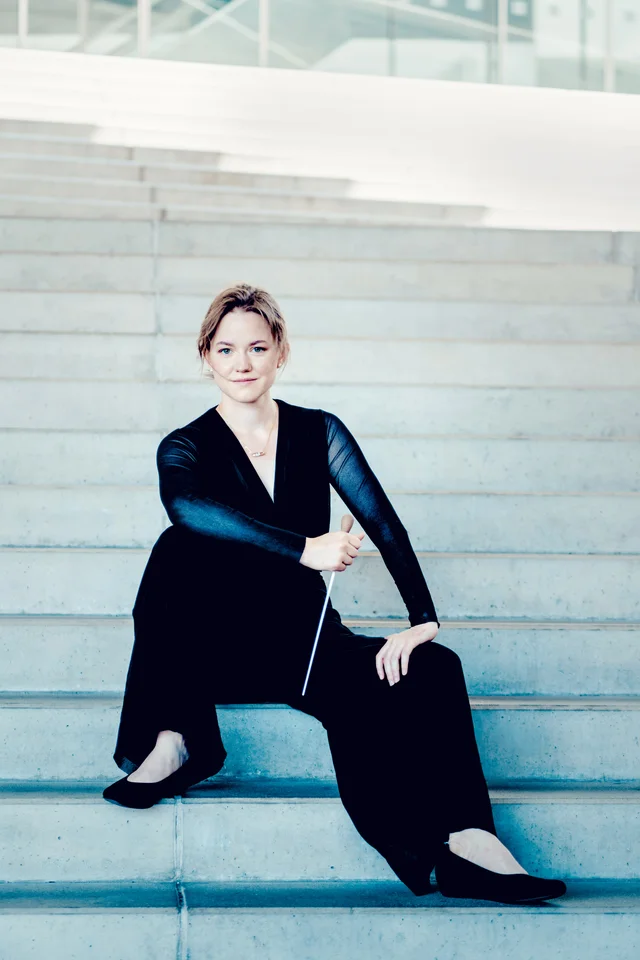
Martina Polek: Katharina Wincor, ‘1001 Nacht’ marks your debut as a guest conductor with the Sinfonieorchester Basel. What drew you to this programme?
Katharina Wincor: Rimsky-Korsakov’s Scheherazade is one of the most important works in the symphonic repertoire. What I love about it is that so many solos are played by members of the orchestra. The whole orchestra gets to shine, which is far less the case in other works. We’ve taken that a step further by opening the programme with Ethel Smyth’s double concerto for violin and horn, played by Friederike Starkloff and Zora Slokar from the Sinfonieorchester Basel. That evening, we are really showcasing talent from within the orchestra, and I think that’s a wonderful approach.
MP: When the soloists come from the orchestra’s own ranks, does that make it easier to bring two such different solo instruments into dialogue?
KW: Yes, definitely. As a rule, an orchestra is especially keen to support the soloists when they are its own colleagues. The atmosphere is usually particularly warm, and that is always a joy, because you get to tap into a kind of collaboration that already exists within the orchestra.
‘What we need above all for Mendelssohn’s ‘Hebrides Overture’ is imagination.’
Katharina WincorMP: When you first get to know an orchestra, is there anything you pay particular attention to?
KW: Every orchestra has its own ‘personality’, shaped by the many individuals in it. As a conductor, that means I have to be flexible and find out as quickly as possible what the orchestra needs from me. Ideally, those few days of rehearsal create a relaxed atmosphere combined with real seriousness, in which we arrive together at a result we all want.
MP: Ethel Smyth was not only a composer but also a prominent suffragette who went to prison for the cause. There’s a famous story that she conducted her fellow campaigners from her cell window as they sang her The March of the Women in the courtyard below, using a toothbrush as a baton. Did this colourful figure inspire the programme?
KW: She is certainly a fascinating character. But for me, choosing a programme is first and foremost about curiosity. Many people don’t know her music, and I myself have only conducted a few of her works. What matters most to me is the desire to discover something new and to share it with the audience, not the politics.
MP: This concert seems less about one solo instrument shining and more about everyone listening to each other. Does that have something to do with how you see leadership?
KW: For me, leadership always means responding to one another. Visually, of course, it can easily look as if the conductor indicates what comes next and everyone else follows. In fact, it’s far more complex, because it’s about so many small details. As a conductor, there’s a great deal I can’t do myself: after all, the music is made by the orchestra. I give impulses, but so do the musicians. Leading and listening constantly alternate.
‘I grew up with three sisters, surrounded by music.’
Katharina WincorMP: Was there an encounter or an experience on your own path as a conductor that left a lasting mark on you?
KW: There wasn’t one single experience. What shaped me was growing up with my three sisters in a very musical family. Our father taught the violin and our mother taught singing. I tried my hand at everything: I learnt the piano, oboe and violin, sang in a children’s choir and played a lot in youth orchestras. Going on to study conducting was more of a spur-of-the-moment decision. At that point, it was simply what interested me most.
MP: Which paths have your sisters taken?
KW: They all became musicians. And I’d like to stress: not because they were made to, but because we were surrounded by music.

MP: Mendelssohn’s Hebrides Overture was written after a journey to Scotland’s rugged coast; you can almost hear the spray and the wind. What does it take on the podium for an audience to really hear a ‘journey’ like this?
KW: The music is highly pictorial, so I need imagination, and so do the musicians. And, of course, a clear idea of how we can achieve that technically. I always feel that when an orchestra plays with real conviction, it carries over to the audience.
MP: Can you tell us whether there’s a particular instrumental solo in Rimsky-Korsakov’s Scheherazade that you’re especially looking forward to?
KW: I don’t have favourites among the solos, more a few favourite passages in the work. The whole piece is incredibly well orchestrated and so wonderfully colourful. When the full orchestra plays together, it sounds with a wealth of colour, and that’s what I’m looking forward to most.