The mind in conflict with itself
Jan Lisiecki is performing Robert Schumann’s Piano Concerto in Basel. For the Canadian-Polish pianist, this is music of a mind wrestling with itself. For Lisiecki, Schumann’s boundless imagination unfolds, on the one hand, in the depiction of an inner landscape and, on the other, in a frenetic variety that is typical not only of the composer but also of our own time.
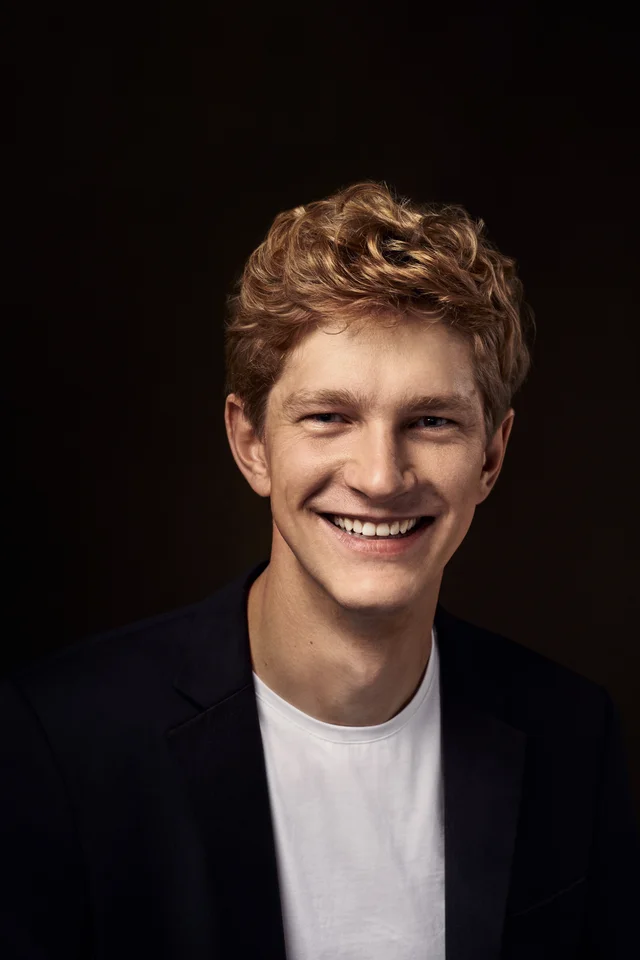
Benjamin Herzog: What does the Schumann Concerto mean to you: a kind of inner landscape, a tone poem, or an opera scene – as I hear it in the slow middle movement of your recording of the concerto?
Jan Lisiecki: Yes, the slow movement in particular strikes me as an opera scene. Of course, we know that the first movement was written separately from the rest of the concerto, and you can sense that very clearly, because this first movement is already a self-contained story that contains everything it needs to stand on its own. But then Schumann, I believe at Clara’s request, added the other two movements to it. It’s done very skilfully. The second movement, for instance, begins in a truly unique way: this sort of invitation from the piano to the orchestra and the orchestra’s response to it – it’s simply brilliant. In a way, with Schumann you always have the struggle between the inner and the outer. His compositions always show us these two characters, constantly competing with one another. His own spirit is at war with itself – I believe you find this stark contrast time and again in Schumann’s work.
BH: So one could say that Schumann’s piano concerto describes, in a poetic way, a landscape of the soul?
JL: I think so. Even though the cadenza of the first movement, or the whole of the third movement, is quite extroverted. This third movement is a game, a very amusing game, also in its interplay with the orchestra.
BH: Franz Liszt once said that the Schumann concerto was a concerto ‘without a piano’.
JL: I believe the best piano concertos are those that focus on the interplay between the piano and the orchestra, rather than displaying the sort of pianistic brilliance that was the most important thing for Liszt himself, as a piano virtuoso and composer. Seen in that light, that was the best compliment Liszt could have paid. Schumann deliberately set out to write a concerto that wasn’t like the other piano concertos of his time – not a showcase for a virtuoso. And he certainly succeeded in that.
BH: If you were now offered a Rachmaninoff concerto – a composer who definitely wrote concertos ‘with’ the piano – would you still play it?
JL: Of course. But take the Second Rachmaninoff Concerto in particular – the melodies are so well-known, and Rachmaninoff repeats them constantly. You don’t get that ‘repetitive’ effect with Schumann, nor with Mendelssohn. There, one idea follows another in quick succession. Hardly anything is properly developed before the next thing comes along …
BH: Very contemporary, when you think of the short attention spans we have these days.
JL: Yes, with their music, these composers are saying: ‘That was good, but I’ve got an even better idea, and then another one that’s even better.’ You never get bored.
‘If you strive only for perfection in music, you distance yourself from art.’
Jan Lisiecki
BH: You mentioned it: Schumann’s Piano Concerto was originally conceived as a single-movement fantasia. However, he then opted for the classical three-movement form, partly because it made it easier for him to find a publisher. So, in a sense, Schumann gave in to commercial pressure. Even back then. And today: what can we all do to resist this pressure in the classical music business – pressure which is, after all, much greater today?
JL: Quality is certainly the most important factor here. Quality often suffers for commercial reasons. Added to this is the fact that the audience, particularly after the pandemic, has tended to demand the familiar – Beethoven’s Fifth, for example – and the big names among performers. After Covid, it became more difficult to play music that wasn’t so well known. That does have its good side, though. People went to concerts because they genuinely wanted to hear what was being played. Now it’s once again our responsibility to balance the familiar with the unfamiliar in our concert programmes.
BH: Are you succeeding in that?
JL: Yes, best of all in my solo recitals. That really is my world, my sphere. There, I can combine pieces that are popular and that everyone loves with repertoire that is perhaps not so well known. It’s less straightforward in concerts with an orchestra. The Schumann concerto is simply much easier to integrate than, for example, one of the composer’s two concert pieces, Op. 92 and 34 …
BH: …which you’ve recorded on CD alongside the Piano Concerto…
JL: …and which, at just 15 minutes each, are also shorter and therefore more difficult to programme. There might be one organiser who’ll take that on. But everyone else wants the concerto after all. Added to that is the fact that these two concert pieces are much more difficult to play, and I spend more time practising them. It’s all a question of balance. Sometimes you can do something special, for example on a recording. And sometimes pragmatic considerations come into play.
BH: You’re one of the world’s top pianists. That brings with it high expectations and the pressure to succeed – how do you deal with that?
JL: Naturally, I want to live up to those expectations. If people come to a concert expecting high quality, then I’ll give them exactly that. But ultimately, it’s also about enjoyment – enjoyment for myself and for the audience. Yes, it’s certainly possible to get bogged down in the pursuit of perfection. But if you strive only for perfection in music, you distance yourself from art, and so – here too – it’s always a question of balance. Of course, at the highest level, it’s primarily about being able to play perfectly. But even more important than playing the right notes is using that ability to express yourself beyond them. And you must always be aware of precisely this tightrope walk.