‘My family say I’m an optimist!’
Is fate an adversary or a source of inspiration? Conductor Robert Trevino has a clear view on the matter. In an interview with Oliver Kerstholt, he talks about the barriers he would like to break down in the music world, about who accompanies him invisibly on stage, and what Schostakowitsch and Tchaikovsky demand of him. His answer: everything.
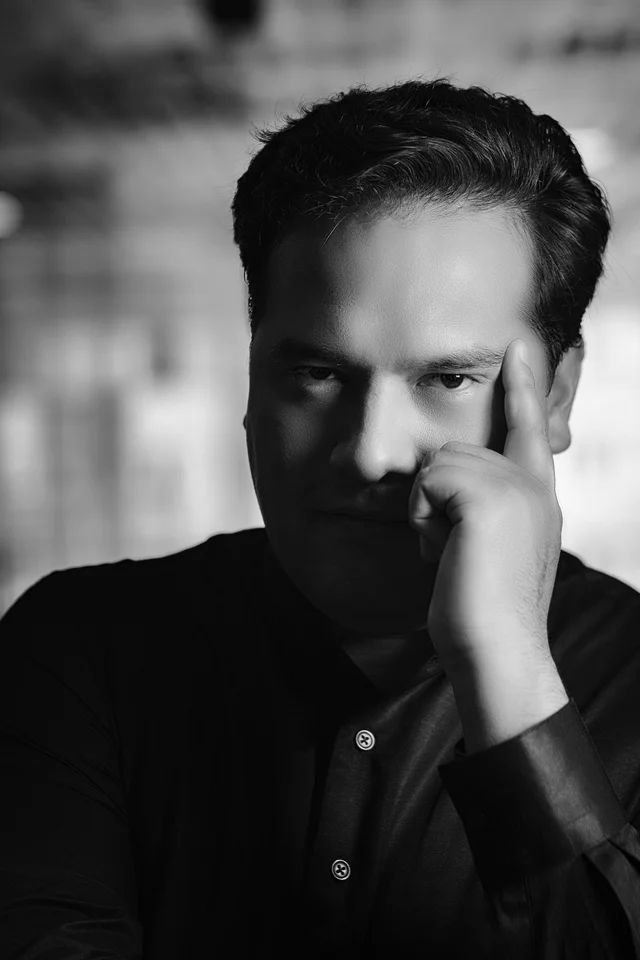
In his performances, Robert Trevino combines quiet passion with extraordinary discipline. This is evident in the precision of his beat and the deceptively restrained – yet imperceptibly powerful –
gestures of his conducting. These qualities have established him as one of the outstanding conductors of the younger generation. In Basel, he will present Dmitri Schostakowitsch’s Cello Concerto No. 1 – a work the composer wrote for his friend, the renowned cellist Mstislav Rostropovich – as well as Pyotr Ilyich Tchaikovsky’s Symphony No. 4: the ‘Fate’ Symphony.
Oliver Kerstholt: Robert Trevino, the theme of your performance in Basel is ‘Fate’. Fate has been kind to you. Is it fair to put it that way, with a touch of simplification?
Robert Trevino: I must admit, fate hasn’t dealt me the worst of blows! On the other hand, I’ve always assumed in my life that we all have a destiny, and if we do our best, fate is perhaps more of a source of inspiration than an adversary. In any case, my family always tells me I’m an optimist!
OK: Against this backdrop, you’ve made it your mission to break down the walls that still exist in the classical music world. Or rather, to tear them down?
RT: We find walls everywhere. Within ourselves, in our attitudes towards others, on the fringes of our society and at national borders. Perhaps that’s why I’m trying, in my own modest way, to remove some of them. First and foremost within my art form, but most convincingly, I suppose, amongst the people with whom and for whom I make music. Take the wonderful audience of the Basel Symphony Orchestra, whom I have grown so fond of over the course of our long-standing collaboration: Every time the orchestra and I perform, we give ourselves to the audience wholeheartedly and without reservation – isn’t that the opposite of a ‘wall’? When we accept critics or listeners for whom our interpretation on a particular evening may not have been their favourite, whilst at the same time appreciating those who were moved – isn’t this openness the opposite of a wall? How about travelling back in time to the year 1799 to play a work by Beethoven, or to the year 1913 to play a work by Stravinsky, or to the year 2025 to play a work by John Adams – isn’t this transcendence of time the opposite of a wall? To quote my dear mentor, Dr Maya Angelou: ‘If something is human, it cannot be alien to me, for I am human.’
OK: You quote another of your mentors, Kurt Masur, with the wisdom: ‘Listen to the orchestra and its culture. It will teach you to produce good sounds.’ How does this shape your collaboration with the Sinfonieorchester Basel?
RT: Maestro Masur was right, and still is, and his words ring in my ears almost every day. The Sinfonieorchester Basel consists of absolutely exceptional musicians who have spent their whole lives refining their individual skills in sound, expression and interpretation. I’d be a fool not to do my very best to ‘listen’ to them; at the same time, there are the demands of the composers, and the challenges and possibilities presented by concert halls. Somehow, I have the feeling that the Sinfonieorchester Basel appreciates my attention to the composers and my love for its beautiful and powerful sound. Every orchestra has its own distinctive qualities, and then there’s the ‘chemistry’ between the conductor and the orchestra. I can’t speak for the musicians, but personally I love making music with them with all my heart every single time!
‘We find walls everywhere. In my own modest way, I try to break down some of them...’
Robert TrevinoOK: Is there anyone who accompanies you, in a metaphysical sense, into the concert hall?
RT: (laughs) I’ve never been asked that question before. But yes, actually. The answer is a bit vague, but I hope it’s clear enough nonetheless. First and foremost, I think of God, my Creator and Protector. For I am well aware of how small I am, how little power I have, and yet I am still able to achieve so many extraordinary things through music and with my family. How could I, who am so small, possess so much power to make a difference and bring light into the world, had I not been gifted with something divine? This is my very personal feeling, and I share it sincerely with the readers of this magazine. I also think of my family. I think of how I make them proud when I go on stage, especially when they aren’t with me, and I also think of how I cherish every moment and create something that cannot be put into words. You see, I find it quite difficult to be separated from my wife and son so often. That is the greatest sacrifice that they and I make for my love of music. So, before I go on stage, I hope that what I do makes them proud and gives them the feeling that my physical absence is justified. And finally, I think of all those who helped me, taught me and shared their knowledge with me, so that this moment of making music is possible. When I step onto the stage, I am not alone; I am accompanied by the many who have loved me and continue to love me.
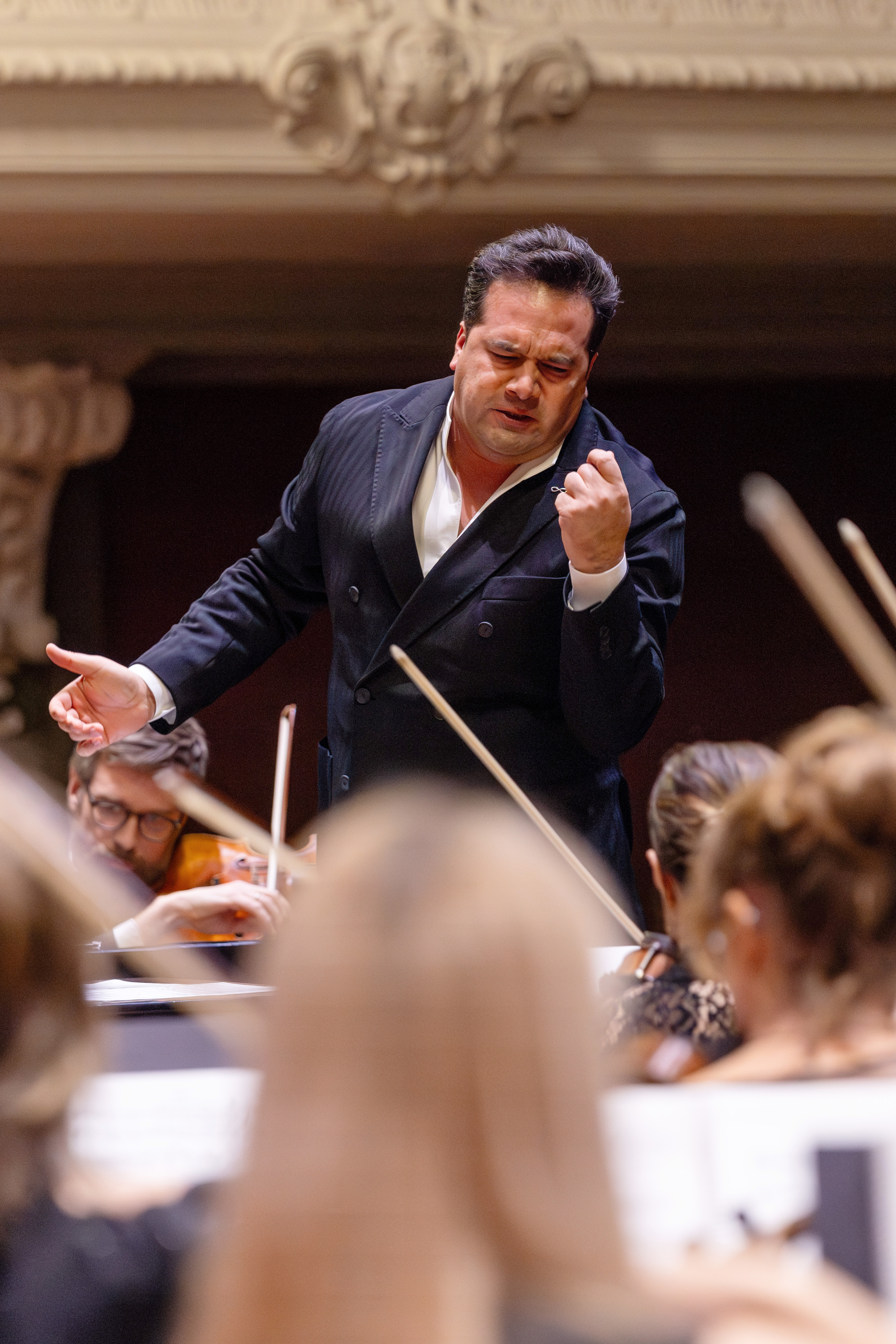
‘When I step onto the stage, I am not alone; I am accompanied by the many who have loved me and who still love me.’
Robert TrevinoOK: You are known for your high standards, have even described yourself as a ‘fighter against mediocrity’ and, as you’ve just mentioned, feel a strong sense of commitment to composers. What do Schostakowitsch and Tchaikovsky demand in the works you are performing in Basel?
RT: The ‘fighter’ bit is true, but I also see myself as a champion of excellence! As a defender of the musicians, the orchestra and, indeed, the composers too. Because a conductor can destroy a musician or an orchestra; these are sensitive, talented people. I do my best to protect them, to help them wherever I can, to give them advice and guidance, to support, encourage, inspire and also celebrate them. Composers need an advocate; that’s what the score is for – in it I see everything they long for, and my task is to help them as best I can to realise the aims of their compositions. So what do Tchaikovsky and Schostakowitsch demand? In my opinion: everything!
OK: Schostakowitsch was, in his own way, rebellious. Is that an attitude you – today – can see the value in?
RT: Yes and no. Fortunately, I do not live under such a dangerous and repressive political regime. But I believe a certain defiance is also needed in times of ‘cancel culture’ and in an immensely provocative political environment. I also admit that, as a conductor, it’s not really my place to address political issues whilst representing a cultural institution and the people within it. I try very hard to avoid politics, as Schostakowitsch practised it. But I have my humanist priorities, and fortunately for him and for me, music is effective even without forcing the issue. I think there are enough people dictating to others what they should think; too many answers, too few questions.
OK: Schostakowitsch’s Cello Concerto captivates from the very first note to the very last. We experience pain, anger and, in the second movement, grief as well. The finale is infinitely heavy. And Tchaikovsky’s Fourth is also a veritable drama of the soul, albeit with an explosive dance of joy at the end. How did you approach this supposedly sombre evening?
RT: Both works differ greatly from one another in this respect. Schostakowitsch is emotionally mechanical. One is faced with an industrial-style machine that causes pain, suffering and loss. As for Tchaikovsky, the symphony is tragic; I regard the finale as ‘manic’ rather than cheerful – a sort of hysterical, euphoric leap into an uncertain but hopeful future. The sonic worlds of these two composers are completely different, so this will take up the bulk of my attention. In my opinion, it is entirely wrong to play Tchaikovsky in the ‘Soviet’ style, as his music stems more from an imperialist aesthetic. Schostakowitsch’s music, on the other hand, is shaped by the world wars and the era of mechanisation.
OK: And with so much emotion on an evening like this, how do you personally feel?
RT: Normally, it’s associated with a lot of adrenaline and euphoria. It’s never a ‘passive’ experience for me.
OK: Do you know, or have any idea, how the musicians in the orchestra experience a performance like this?
RT: Based on my previous concerts with the orchestra, I believe the same applies to them.