Rapids of life
Composer Outi Tarkiainen comes from one of Finland's northernmost regions, Rovaniemi, the capital of Lapland. However, her music is neither cold nor distant: as part of a generation following on from late 20th-century Finnish postmodernism, Tarkiainen, who celebrated her 40th birthday this year, draws on intuition, emotions and storytelling.
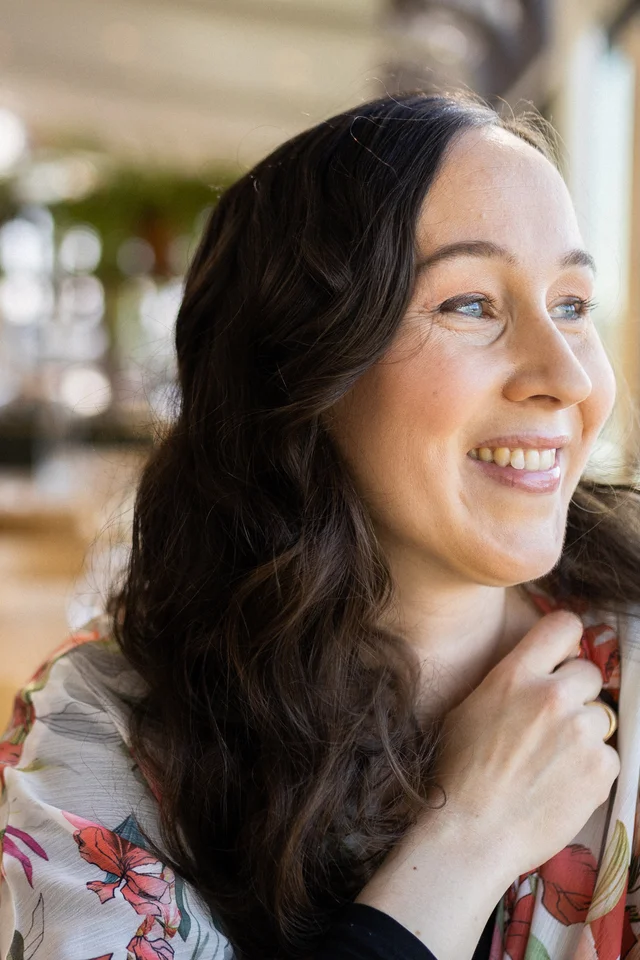
The composer continues Finland's rich musical heritage, from folk music to Jean Sibelius and Kaija Saariaho: the expansive soundscapes she creates are also influenced by her close proximity to nature in the Arctic Circle. Her works bear evocative titles such as Polar Pearls, Songs of the Ice and Midnight Sun Variations. In The Rapids of Life, Tarkiainen refers to one of her most personal experiences: the birth of her own son. Pekka Kuusisto premiered the intimate, ten-minute orchestral piece with the Helsinki Philharmonic Orchestra in October 2024 and will also conduct it at the concert in Basel.
Lea Vaterlaus Outi Tarkiainen, the title of your work The Rapids of Life alludes to the various “rapids” we encounter in the course of our lives. When have you experienced such surprising moments?
Outi Tarkiainen I believe that people have far less control over their lives than they would like. We assume that we will live long and healthy lives, yet we are constantly caught up in “rapids”, or fast currents. While I was writing this piece, our great Finnish composer Kaija Saariaho passed away unexpectedly early in June 2023, which affected me deeply. Kaija was a great role model for me, and we were in regular contact until shortly before her death. These unexpected moments are probably part of growing older and part of life.
LV However, this work does not describe the end, but rather the beginning of life. You have set your own experiences of childbirth to music...
OT The Rapids of Life is a truly unique piece, because I don't normally work with explicitly programmatic content. However, the birth of my first child was such an unexpected experience for me that I wanted to capture it musically. In Iceland, I once stood in front of one of the most dangerous rapids in Europe. The force of the water reminded me of the contractions before the birth. At that moment, I felt as if I were being swept away by wildly rushing water. Musically, this piece features strong dynamic crescendos with sudden drops in energy – like contractions that build up and then suddenly subside again.
‘I believe that people have far less control over their lives than they would like to have.’
Outi TarkiainenLV The music builds up in waves, but stagnates shortly before the final orchestral crescendo. What are we hearing here?
OT In a brief moment, after the pain during labour had become unbearable, I experienced a sudden calm, as if my body and muscles had to prepare for the final contraction. In medicine, this is referred to as the “Ferguson reflex”, which kicks in here to unconsciously support the body during childbirth. This is followed by the climax, the final contraction, during which the child is finally born within a few minutes. In The Rapids of Life, the orchestra utters the cry ‘Ei!’, which means ‘No!’ in Finnish. When my son was born, this exclamation triggered an unexpected power within me. This strength of the female body is, for me, the most impressive “rapids of life” I have ever experienced.
LV In The Rapids of Life, there are also specific references to other Finnish composers...
OT The big cello solo at the beginning is a direct reference to a cello piece by Kaija Saariaho. Following her death, many of my acquaintances published texts and letters to Kaija – but I couldn't find the words. Instead, I incorporated the instruments that were closest to her – the trumpet, the flute and the cello – into the piece as a memorial to her. Like the “flame of life”, they run through the labour pains of the beginning. As soon as the child is born, the music changes abruptly. The child opens its eyes for the first time and enters a fairy-tale world, illustrated by soft glockenspiel and strings. The Rapids of Life finally ends with the characteristic beginning of Sibelius' 4th Symphony. For me, this brings things full circle.
LV Did it take courage to write a work on such an intimate subject?
OT In the run-up to the premiere of this piece, I actually asked Pekka Kuusisto whether I was allowed to write about such an unusual subject for classical music. He immediately replied: ‘Absolutely!’ In our society, humans are becoming increasingly distant from nature. Yet humans are no different from nature. On the contrary – we are part of the ecosystem, and birth is the beginning of every human life. It is also a highly complex process: it was only recently discovered that a child's cells remain in the mother's body for decades after birth! May men have not been particularly interested in the subject until now because it is not part of their world and they do not remember the birth. To be honest, no man would ever set the process of birth to music. The Rapids of Life is therefore not a decidedly feminist piece, but it tells of an experience that was the most formative in my life.
Interview: Lea Vaterlaus