Benjamin Herzog A few years ago, you wrote a lyrical diary in which you said: "Where I come from, it's a bit like the Wild West. Straubing lies on a large plain. Floodplains of the Danube, the wide horizon ending only in the north, at the Bavarian Forest. In summer it gets very hot, and at my friend's farm the dust from the grain was everywhere." That's a very romantic and very German memory, isn't it?
Christian Gerhaher It was actually very beautiful there. I don't know if it was romantic, and it may not have been German either. For me, it was just like the Wild West. A contrast to the more educated middle-class atmosphere in which I grew up. Friends and relatives – there was a lot of music, literature and art. In retrospect, that was perhaps the great idyll.
BH Later, this scene is interrupted by a jet plane flying low overhead. This kind of disruptive experience is characteristic of modernism, which I would say includes Gustav Mahler's Wunderhorn Lieder, composed 130 years ago. Do you sing Mahler with this “low-flying experience” in mind?
CG I find that a very interesting association. For me, this story was more about delayed perception. I was on the phone and heard this jet flying past my friend through the receiver. A few seconds later, it was in vivo with me, like the physical arrival of a message – this triggered in me a sense of great significance, which I only later learned to classify concretely: many songs talk about messages, “love messages”. And that is perhaps the most important topos of 19th-century Germany. It is a constant theme in Schumann, in Beethoven's Ferner Geliebte, in Schubert's opening of Schwanengesang, and also in the Suleika songs. In Mahler, it appears at most in Rheinlegendchen. Although Mahler was socialised in the Romantic tradition, his particularly ambiguous effect makes him rather modern. For me, it was a bit like that with my own childhood. I grew up in a medieval town on the Danube, which was nevertheless characterised by modernity. I find this interesting in Mahler's case in that he had one foot in this modernity, but he did not understand it as such – in his own words. You could say that Mahler's music seems modern with all these set pieces, this collage technique. Yes, but these set pieces, the Jewish clarinets, the military marches and so on – all of that comes from the past. These collages in Mahler's work only ever provide a narrative framework; basically, the various moments that pretend to be part of a narrative stand more or less helplessly side by side.
BH In the sequence of your selection of the Wunderhorn songs, a man condemned to death encounters Saint Anthony, who is preaching to the fish. While the persecuted man in the tower praises freedom of thought, these thoughts are not understood at all in Anthony's sermon to the fish. Is this juxtaposition merely cynical, or does this selection want to tell us something else?
CG I selected and combined the songs in such a way that they fit together tonally for me. But because the texts are so good and Mahler's setting of them is so brilliant, it also works on a textual level. Inserting the sermon to the fish is not entirely easy. Of course, there are cynical moments in it, but the humour prevails. It could also be placed alongside the Rheinlegendchen if this song were to be arranged in the style of a dance-like afternoon idyll. But I don't see it that way. Much more important here is the anger and annoyance at the lovers being taken advantage of by a powerful figure. So you see, such connections are made by the performer and are not so much dependent on the composition.

BH When I listen to you, I get the impression that your interpretations are based entirely on the text, on the words. You don't allow yourself to be seduced by a beautiful melody into pure euphony. Is that right
CG Pure euphony, i.e. without any specific meaning, is certainly difficult to imagine. For me, that quickly veers towards entertainment, which is never as good as real light music, but often quickly becomes a little shabby and remains superficial. Of course, as a singer, I have a lot to do with the lyrics. The piano certainly represents the musical side more. But both are fused into a semantic unit in the song, which is expressed in the resulting sound. Our task as singers is to express lyrics that, in the brevity of a song, can never be made completely understandable or understood, in such a way that they can be easily accepted by the audience without reflection. Of course, this also involves narrative arcs and so on. But it is important to allow the possible meaning of the poem to recede behind the meaning of the sound through declamation. Concrete ideas about interpretation are of course unavoidable, but they are also constantly changing – as a performer, I approach the work actively and with a fresh perspective. Nevertheless, my interpretation ideally remains as transparent and untainted as possible so as not to impose a clear interpretation on the audience.
‘Vibrato is a last resort.’
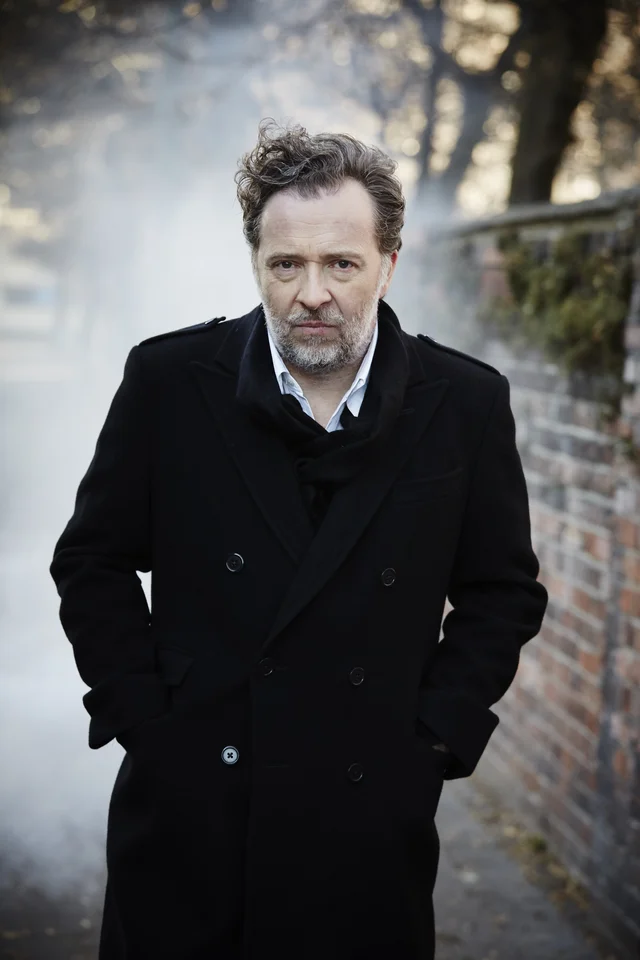
Christian Gerhaher, baritoneBH One means of expression that I hear in your singing is the controlled use of vibrato. You often begin notes without vibrato. That is something I am more familiar with from early music. Do aspects of historically informed performance practice play a role for you?
CG I wouldn't say so, although I do enjoy singing Baroque repertoire. At my advanced age as a singer, non-vibrato is more a means of control. But of course I'm pleased when you say that vibrato acts as an interpretative tool. It is perhaps the most missed, but in any case the least obvious and by far the most mysterious means of expression that we as singers have. There are five in total. At the bottom is agogics – used too arbitrarily and inflationarily, it very quickly becomes generalised and meaningless. Like a general brown colour of pathos. Then comes dynamics. Logically, this is of central importance and also unavoidable, because composers write a lot about it. Then come intonational changes, connected with vocal colour and with the fourth interpretative tool central to song singing, vocal colouring, which of course must not affect vocal colouring, otherwise the intelligibility of the sung language would be compromised. This then has to do with vibrato, which sometimes swings upwards and sometimes downwards and can thus also affect colour and intonation. Intonation is also linked to dynamics, to sound pressure. The last and most mysterious means is vibrato. It consists of an intonational and a dynamic component. Both must come together in synchronisation. Due to the variety of individual parameters, this results in a wealth of possibilities and combinations. It's all really complicated and not explained in detail, but I try to deal with it.
BH But in concert, you have to detach yourself from these technical considerations, right?
CG No, sometimes you have to think about it during a performance. At least that's how it works for me. So is singing a pleasure? Theoretically, yes – if an idea can be realised physiologically.
BH You also sing opera. In Zurich, you sang the title role in Wozzeck, at major venues such as the New York Met you sang Wolfram in Tannhäuser, and recently in Paris you sang the Count in Mozart's Figaro. How well does a schedule combining opera and song work?
CG It's difficult, and I don't find it easy to switch from opera back to song. Singing opera also causes physiological changes. Dietrich Fischer-Dieskau, whom I greatly admired, said that there is only one type of singing, whether in opera or song. But in my opinion, that's nonsense. In piano songs, the multi-coloured nature of the singing is crucial, because the piano is rather monochromatic. In opera, it's exactly the opposite. The orchestra is already very multi-coloured. If I add my own multi-coloured singing to that, it can be difficult, especially in terms of dynamics.
BH Are there breaks between your opera projects and your song recitals?
CG Theoretically, yes. And there are also connections. Wozzeck without song is unthinkable. Berg is said to have written around sixty different instructions for the vocal parts – the polychromatic nature of song comes in handy here. Even Wolfram in Wagner's Tannhäuser actually needs a song background.
BH The boundaries between genres are also fluid in Mahler's work; his Wunderhorn songs find their way into his symphonies. Does that matter to you? Do you think of these songs as “symphonic”?
CG No. Firstly, I'm not a conductor. And secondly, the origins aren't always clear. Which came first: the symphony or the corresponding song, the instrumentation or the piano score? And especially in the Wunderhorn songs, there is a large section of early songs that are not orchestrated. In this respect, I consider the songs to be important for understanding the symphonies, but the symphonies to be less significant for the reception and interpretation of the songs.
Interview: Benjamin Herzog